↓
Reduce biological load from below
Environmental exposures, toxic burden, microbiome disruption, inflammation, and clinically relevant persistent infection may contribute to cumulative physiological demand.


THE LONGEVITY HIERARCHY™
A capacity-based framework for understanding what the body can respond to, what is constraining that capacity, and what needs to happen next.
Published September 2026
Longevity medicine has become extraordinarily sophisticated. We can measure more, track more, personalize more, and intervene earlier than at any point in modern medicine.
And yet, in clinical practice, I repeatedly see a paradox: some of the people most engaged in improving their health remain among the most physiologically unstable.
They may be tracking symptoms and biomarkers, implementing increasingly sophisticated interventions, and working consistently with experienced practitioners. Their efforts often produce benefit, but progress may slow, plateau, or become inconsistent.
The usual response is to optimize harder.
More testing. More tracking. More personalization. Another intervention.
But what if the problem isn’t that we haven’t found the right intervention yet?
What if the system has temporarily lost some of its capacity to respond to it?
Homeostasis describes the body’s ability to maintain or regain physiological stability in the face of changing conditions.
Homeostatic capacity asks something slightly different:
How much physiological demand can this system absorb, adapt to, and recover from while maintaining or regaining stability?
Two patients can have similar diagnoses, similar laboratory findings, and receive the same intervention—yet respond very differently.
One improves. The other becomes more fatigued, reactive, or unstable.
The difference may not lie entirely in the intervention.
It may lie in the state of the system receiving it.
There comes a point at which adding more therapeutic input no longer produces proportional benefit because the body’s ability to receive, integrate, and recover from that input has become limiting.
I call this the Longevity Bottleneck™.
A clinical framework for identifying where biological load may be accumulating, where regulatory capacity may be constrained, and how care can be sequenced accordingly.
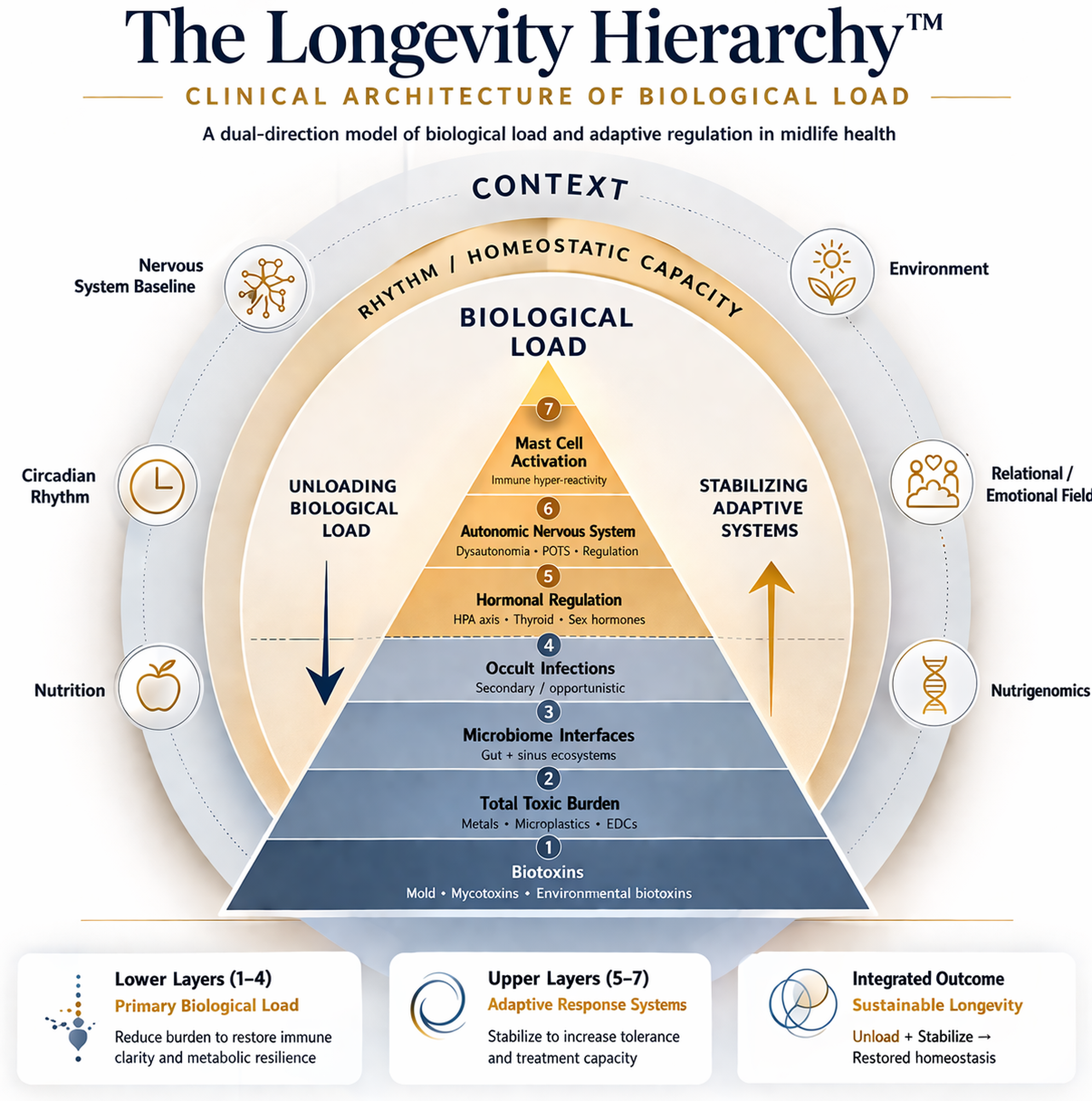
Its clinical application moves in both directions.
↓
Environmental exposures, toxic burden, microbiome disruption, inflammation, and clinically relevant persistent infection may contribute to cumulative physiological demand.
↑
Sleep and circadian stability, endocrine support, autonomic regulation, and stabilization of excessive immune or mast-cell reactivity may increase the system’s ability to tolerate the work of reducing that burden.
The goal is not simply to preserve tolerance. It is to expand homeostatic capacity.
The hierarchy describes the landscape. Longevity Sequencing™ describes how we move through it.
Precision medicine already recognizes that treatment should be individualized and that treatment selection, timing, dose, and sequence may need to change as the patient’s state evolves.
What can this system tolerate and respond to now?
Longevity Sequencing uses current homeostatic capacity, dominant physiological constraints, and the patient’s evolving response to help determine the timing, intensity, and order of intervention.
Sometimes that means addressing biological load. Sometimes it means first—or simultaneously—creating greater regulatory stability. And sometimes it means doing less.
There is another form of physiological demand I have increasingly recognized in clinical practice: the burden of constantly trying to optimize yourself.
Data can be useful. Tracking can be useful. Paying close attention to the body can reveal important patterns. But useful observation can sometimes cross into vigilance.
Sleep scores. Glucose. HRV. Food. Symptoms. Supplements. Exercise. Biomarkers.
When health becomes something that must be continuously watched, interpreted, and corrected, the pursuit of optimization can itself become another source of physiological stress.
The answer is not disengagement. It is a middle path.
Informed attention without hypervigilance.
Enough attention to recognize meaningful patterns and guide care. Enough spaciousness to allow the body to adapt.
Early in my career, I worked with Anthony J. Yun, MD, whose systems-based thinking profoundly influenced my own. Together with our coauthors, we published a hypothesis proposing that narrowing biological dynamic range could contribute to dysfunction—and that expanding biological dynamic range might itself be therapeutically beneficial.
Over the years that followed, caring for patients with complex chronic illness repeatedly brought me back to a related pattern: sometimes the limiting variable wasn’t another diagnosis or another intervention. It was the body’s capacity to respond.
The question evolved from How broad is the system’s biological dynamic range? to: What constrains the organism’s integrated ability to adapt and recover—and can that capacity be expanded?
The Longevity Hierarchy and Longevity Sequencing translate that systems perspective into a proposed clinical framework: identify the constraint, reduce biological load, expand regulatory capacity, and sequence intervention according to the state of the system receiving it.
The integrated ability of the organism to tolerate, adapt to, and recover from physiological and therapeutic demand.
The point at which limited capacity becomes a constraint on therapeutic response.
A clinical framework for identifying interacting contributors to biological load and regulatory instability.
The dynamic ordering, timing, and intensity of interventions according to current capacity, dominant constraints, and evolving response.
READ THE FULL PAPER
A Capacity-Based Framework for Sequencing Longevity Care
Stephanie Daniel, DO · 2026
The complete paper presents the theoretical foundation, seven-level clinical framework, Longevity Bottleneck™, Longevity Sequencing™, clinical implications, scope and limitations, and supporting references.
Version 1.0 · September 2026 · PDF
Stephanie Daniel, DO, is the founder of Functional Medicine SF and a physician practicing personalized, systems-based medicine. Her work focuses on complex chronic illness, hormonal and nervous-system regulation, environmental contributors to disease, and longevity. Her early published work explored evolutionary medicine, biological dynamic range, and adaptive physiology—ideas that continue to inform her clinical approach today.